
How Auto Focus Keyword works
Try the workflow on a fictional site →
Auto Focus Keyword is a keyword population utility. It detects which SEO plugin is active, scans for content with no focus keyword value, and writes the page title into the corresponding meta field.
That is the whole of it. The value comes from doing it across four hundred pages in a few minutes rather than from any cleverness in the choice.
SEO plugin detection
The plugin checks which SEO plugin is installed and active, then writes to the correct meta key:
| SEO plugin | Meta key used |
|---|---|
| Yoast SEO | _yoast_wpseo_focuskw |
| Rank Math | rank_math_focus_keyword |
| All in One SEO | aioseo_posts table, keyphrases JSON |
| SEOPress | SEOPress target keyword post meta |
If none of these is active, the plugin cannot operate and says so rather than writing anywhere. The SEO Framework is not supported.
WARNING
Running two SEO plugins that both own focus keyword data is not recommended, independently of this plugin. Each stores the field in its own place, and they will disagree about which is authoritative. Pick one.
What the scan actually does
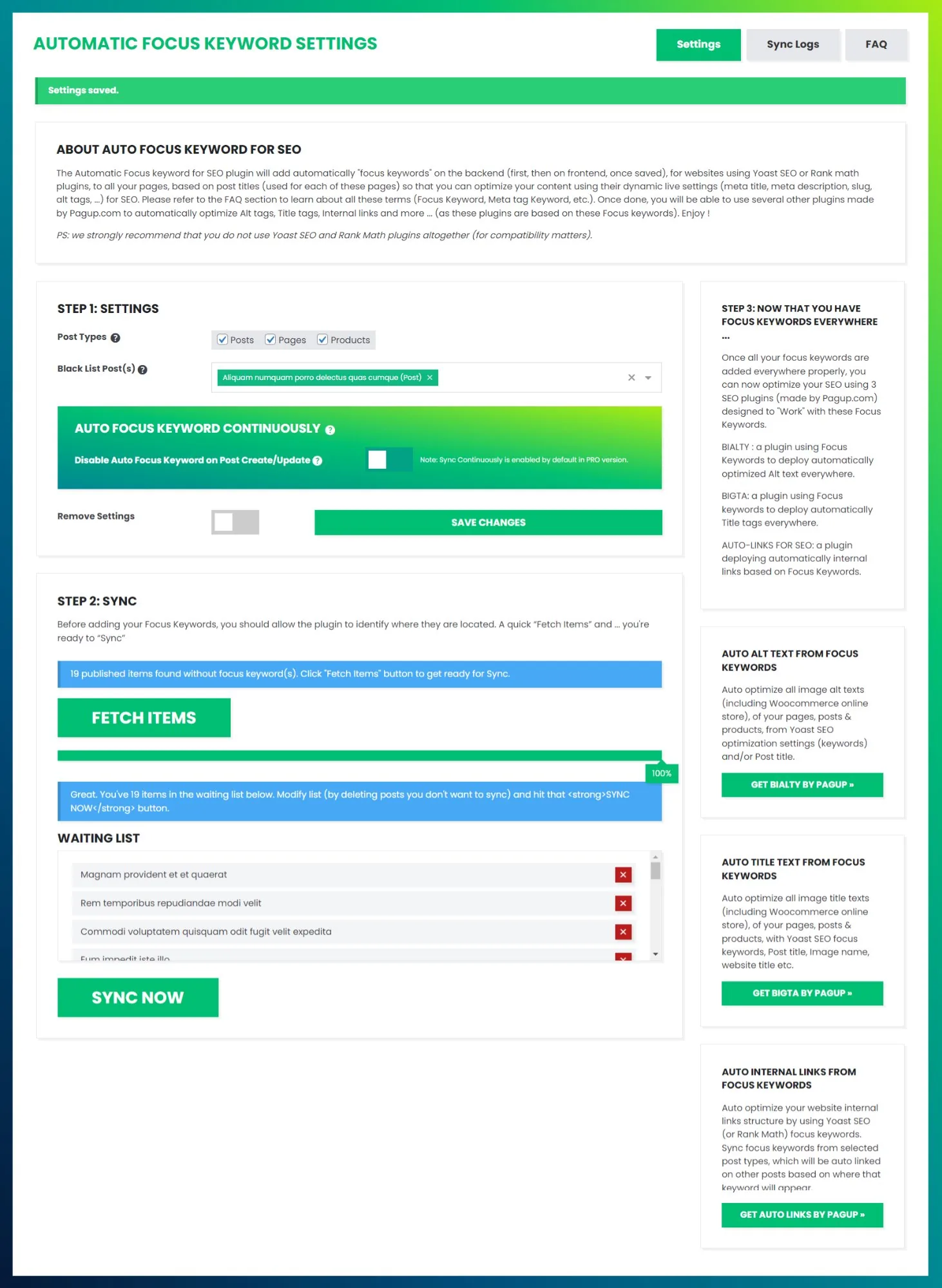
When you click FETCH ITEMS, the plugin runs a database query that:
- selects all published posts matching your chosen post types;
- left-joins the postmeta table looking for the focus keyword meta key;
- returns only rows where that key is missing or empty;
- drops anything you have blacklisted;
- processes the result in batches, so the request does not time out.
Nothing is written at this stage. FETCH is a diagnosis, and it is useful on its own: the count of items with no focus keyword is an instant coverage metric that costs nothing to produce.
Scope: which content is covered
| Post type | Free | Pro |
|---|---|---|
| Posts | ✓ | ✓ |
| Pages | ✓ | ✓ |
| WooCommerce products | — | ✓ |
| Custom post types | — | ✓ |
Posts and Pages are selected by default.
Product coverage is where the Pro tier earns its place on a catalogue site. On a store with hundreds or thousands of products, the focus keyword field is almost never populated by hand, and the product name is almost always the right target: it is specific by nature, and it is what customers search.
What it deliberately does not do
- It does not do keyword research. No search volume, no difficulty, no competition. It copies the title you already wrote.
- It never overwrites an existing focus keyword. Only empty fields are touched, so anything you set by hand is safe.
- It does not change what visitors see. The focus keyword is a backend field, and Google does not read it directly.
Read next
- Fetch and sync — running it, the log, and continuous assignment
- Using it well — limits, exclusions, and the hybrid strategy
- No focus keyword set — the problem this addresses
- The pipeline — what consumes the keyword layer afterwards